



Many business owners assume that if they have a website, they should eventually rank on Google. Unfortunately, that is not how it works. A website can look decent on the surface and still have hidden problems that make it harder for search engines to understand, trust, and rank. In many cases, these problems are not dramatic. They are small structural, technical, and content-related mistakes that quietly weaken performance over time.
The frustrating part is that these issues often go unnoticed. A business may wonder why traffic is low, why service pages are not ranking, or why competitors keep showing up above them in search. The answer is often not a single massive failure. It is a collection of website mistakes that damage visibility and reduce the site’s overall strength.
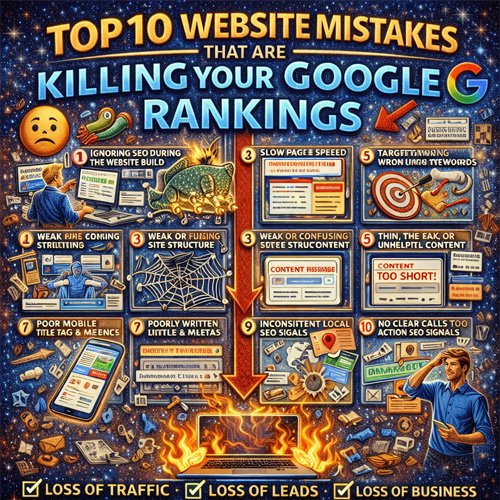
If your website is not performing the way it should, the problem may not be the market. It may not even be the competition. It may be the foundation of the site itself. Here are ten of the most common website mistakes that can quietly destroy your Google rankings and hold back your business growth.
1. Ignoring SEO During the Website Build
One of the biggest mistakes businesses make is treating SEO like something that can be added later without consequences. When a site is designed without SEO in mind, it often ends up with weak structure, poor page targeting, awkward navigation, missing metadata, and content that does not align with search intent.
Search engine optimization works best when it is part of the site’s foundation. That includes page planning, internal linking, headings, speed, mobile usability, and content strategy. Waiting until after launch usually means spending extra time and money fixing problems that could have been avoided from the start.
2. Slow Page Speed
A slow website can hurt rankings, user experience, and conversions all at once. Visitors do not like waiting for pages to load, and search engines know that. If your site loads too slowly, people are more likely to leave before engaging with your content.
Slow performance often comes from oversized images, bloated code, too many scripts, poor hosting, or unoptimized design elements. Even if the site looks attractive, it may be losing ranking strength because it delivers a frustrating experience.
Faster websites tend to create better engagement, and better engagement often supports stronger search performance.
3. Weak or Confusing Site Structure
Search engines need to understand how your website is organized. Visitors need that too. If your menus are confusing, service pages are buried, or the overall page hierarchy is unclear, your website becomes harder to crawl and harder to use.
A poor site structure can make important pages less visible to both Google and your audience. It can also weaken the relationships between your pages, which makes it harder for search engines to understand topical relevance and page importance.
A clean structure with logical navigation and purposeful internal linking gives your website a stronger chance of ranking well.
4. Targeting the Wrong Keywords or No Clear Search Intent
Some websites try to rank for terms that are too broad, too competitive, or not connected to what their ideal customers are actually searching for. Others do not target anything clearly at all. They create vague pages with generic headlines and unclear service language.
Google wants to match pages with search intent. If your page does not clearly align with what a searcher wants, it will struggle to rank. This is why service pages, blog posts, and location pages should each have a clear purpose.
Ranking is not just about using keywords. It is about creating the right page for the right search.
5. Thin, Weak, or Unhelpful Content
A page with very little substance has a hard time competing in search results. Many business websites have thin service pages that barely explain what the company does, who it helps, or why someone should choose it. That kind of content rarely performs well.
Search engines are trying to show pages that are useful and relevant. If your content is too short, too generic, or too shallow, it may not give Google enough reason to rank it above stronger competitors.
Good content should answer real questions, explain services clearly, support trust, and align with what the visitor wants to know.
6. Poor Mobile Experience
A website that performs badly on mobile devices can lose both rankings and conversions. Many users search from phones first, especially for local services and quick decisions. If the mobile version of your site is hard to navigate, slow to load, or difficult to read, users may leave quickly.
Google also pays close attention to mobile usability. A site that is not mobile-friendly can struggle even if the desktop version looks acceptable. Buttons should be easy to tap, text should be readable, menus should work smoothly, and forms should be manageable on small screens.
7. Missing or Poorly Written Title Tags and Meta Descriptions
Title tags and meta descriptions help search engines and users understand what a page is about before they click. If these are missing, duplicated, or poorly written, your pages lose an opportunity to communicate relevance and improve click-through performance.
A strong title tag should reflect the main topic of the page clearly. A good meta description should support that topic and encourage the user to click. These elements are small, but they matter. When ignored across an entire site, they can weaken overall search performance.
8. Broken Internal Linking or No Internal Strategy
Internal links help Google understand how your pages relate to each other. They also help visitors discover more relevant content. When a website has no thoughtful internal linking strategy, important pages can become isolated and harder to support in search.
For example, your homepage should usually link to key service pages. Service pages may link to related blog posts or location pages. Blog content should often point back to core services or contact pages. These connections strengthen the site’s overall structure and make it easier for both search engines and people to move through your content.
9. Inconsistent Local SEO Signals
For local businesses, inconsistent local information can create ranking problems. If your business name, address, or phone number appear differently across your website and important online listings, that inconsistency can weaken trust and relevance.
Local visibility depends on clarity. Your website should clearly communicate where you are located, what areas you serve, and how customers can contact you. Location pages, Google Business Profile details, service area content, and NAP information should all support one another rather than creating confusion.
10. No Clear Calls to Action or User Path
This may seem more like a conversion problem than a ranking problem, but it matters more than many businesses think. Google pays attention to how people interact with websites. If visitors arrive and quickly leave because the site feels confusing or directionless, that weak engagement can reflect poorly on the overall quality of the experience.
A strong website should make it clear what the visitor should do next. Whether the goal is requesting a quote, calling the business, reading more, scheduling a consultation, or buying a product, the site should guide users naturally. Better user engagement often supports better business results and a healthier site overall.
Why These Mistakes Often Go Unnoticed
The hardest part about website mistakes is that many of them are quiet. A page may still function. A menu may still open. The site may still exist online and even get some traffic. But small weaknesses add up. When enough of them are present, the website becomes harder to rank, less persuasive to visitors, and less effective as a business asset.
That is why businesses sometimes feel stuck. They know the site is not producing what they expected, but they cannot easily identify which parts are working against them. In many cases, these ten mistakes are a good place to start looking.
What Stronger Websites Usually Do Differently
Websites that rank better on Google usually share a few strengths:
- They are built with SEO in mind from the start
- They load quickly and work well on mobile devices
- They have clear structure and internal linking
- They target real search intent
- They include useful, relevant content
- They support local relevance when needed
- They guide visitors clearly toward action
These are not gimmicks. They are signs of a website built to perform well for both users and search engines.
Final Thoughts
Google rankings are often lost quietly, not dramatically. A collection of small website mistakes can slowly weaken visibility, limit traffic, and reduce your ability to compete online. The good news is that these problems can often be fixed once they are identified.
At WebDesignerProSEOExpert.com, the best results come from treating your website like a strategic business asset, not just an online placeholder. When you eliminate the mistakes that hold rankings back and build around strong design, structure, content, and SEO, your website becomes much more capable of attracting the right traffic and turning it into real business growth.