



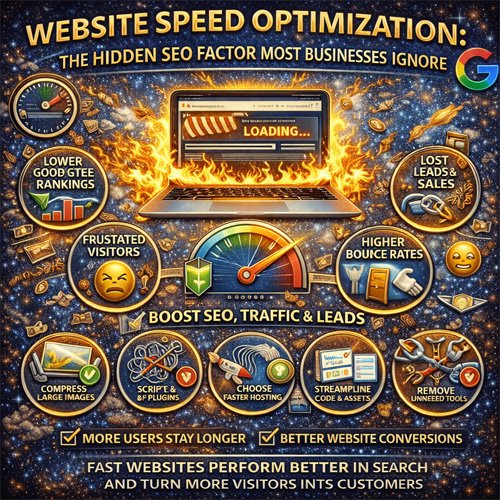
 Many businesses focus on keywords, content, backlinks, and design when trying to improve search rankings, but they often overlook one of the most important performance factors on the site itself: speed. A website may have strong content and a polished appearance, yet still underperform because it takes too long to load. That delay can quietly damage rankings, weaken user trust, reduce engagement, and cost the business valuable leads.
This is why website speed optimization matters so much. Page speed is not just a technical detail for developers. It is part of the overall experience Google wants to reward and users expect. A slow site creates friction at the exact moment when a visitor is deciding whether to stay or leave. In many cases, speed becomes the difference between a website that helps the business grow and one that quietly turns opportunity away.
Businesses often ignore speed because it is less visible than design. They notice colors, layouts, images, and branding right away, but they may not realize how much performance affects the site’s ability to rank and convert. That makes speed one of the most hidden SEO factors and one of the most valuable to improve.
Why Website Speed Matters for SEO
Search engines want to send users to pages that create a good experience. A site that loads quickly, responds smoothly, and makes information easy to access is usually more helpful than one that feels slow and frustrating. That is why speed supports SEO.
When a page is slow, users are more likely to abandon it before they engage. If enough visitors have a poor experience, the site becomes weaker as a search result. Google wants to rank pages that satisfy user needs, and performance is part of that.
Speed also affects how efficiently a site feels overall. Even strong content loses value if visitors leave before they ever read it. In that way, speed is not separate from SEO. It is part of what makes SEO work.
Speed Shapes First Impressions Immediately
A website’s first impression is not only visual. It is also emotional. Visitors notice how quickly the page responds, how smooth the experience feels, and whether they can access what they need without delay.
If a site loads slowly, the business may appear less professional, less modern, or less trustworthy before the visitor even reads a word. That first impression matters. People often make fast judgments online, and slow performance can create doubt right away.
A fast website feels sharper, more reliable, and easier to trust. Those subtle impressions help support both engagement and conversions.
Slow Websites Lose Visitors Before the Real Experience Begins
One of the biggest problems with poor page speed is that it prevents the rest of the website from doing its job. Your messaging, service pages, testimonials, offers, and calls to action only matter if people stay long enough to see them.
A slow website interrupts the visitor journey before it begins. Some users leave before the page fully loads. Others stay but feel annoyed enough to trust the site less or interact with it less deeply. Either way, the business loses value.
This is one reason speed optimization often creates outsized impact. It improves the environment in which all the other parts of the website operate.
Website Speed Affects Conversions, Not Just Rankings
Businesses often talk about speed only in relation to SEO, but its impact goes further. A faster website can improve lead generation, increase form submissions, support more calls, and help more users complete purchases or contact actions.
That happens because speed reduces friction. When users can move through the site smoothly, they are more likely to continue exploring, read service details, trust the offer, and take the next step. When the site drags, hesitation increases.
In many cases, improving speed means getting more value from the traffic you already have. That makes it one of the most practical improvements a business can make.
Mobile Users Feel Speed Problems Even More
Website performance becomes even more important on mobile devices. Mobile users are often searching on the go, using cellular connections, or trying to take quick action. They have less patience for slow-loading pages and less tolerance for heavy, awkward websites.
If your mobile pages are slow, you may lose visitors who were actually close to becoming leads. A person searching for a contractor, dentist, consultant, or local service on a phone may be ready to act quickly. A slow page can interrupt that intent and send them elsewhere.
This is why page speed optimization is not only a desktop issue. It is a major mobile usability issue too, and mobile experience plays a large role in modern SEO.
Common Reasons Business Websites Are Slow
Many websites become slow for preventable reasons. The problem is often not one dramatic failure, but a collection of choices that add weight and inefficiency to the site.
Common speed issues include:
- Oversized images that are not compressed
- Too many plugins or scripts
- Heavy animations and effects
- Poor hosting quality
- Bloated page builders or code
- Unoptimized fonts, videos, or media files
- Too many third-party tracking tools
Any one of these can weaken performance. Together, they can create a slow site that quietly damages SEO and usability.
Fast Websites Usually Feel Simpler and Stronger
One hidden benefit of speed optimization is that it often improves the design and clarity of the website at the same time. Businesses forced to think about performance usually start asking better questions: Which elements are essential? Which visuals truly support the message? Which features add value, and which only add clutter?
That process often leads to a cleaner, more focused website. Instead of relying on excess movement, decorative overload, or heavy media, the site becomes more intentional. The result is not only faster performance, but a stronger user experience overall.
In that sense, speed optimization often improves quality by forcing clarity.
Speed Supports Better Engagement Signals
A faster website gives users a better reason to stay, click, and continue exploring. That can support stronger engagement, which helps the site function more effectively overall. Pages that load quickly are easier to use, easier to trust, and easier to experience as helpful.
Better engagement may include:
- More time spent on the page
- More service pages viewed
- Lower bounce rates
- More interactions with calls to action
- More completed forms or purchases
These improvements matter because they reflect a healthier relationship between the user and the website. Speed helps create that relationship by removing one of the earliest points of frustration.
Local Businesses Cannot Afford to Ignore Speed
For local businesses, speed can be especially important because local searches often come with strong intent. Someone looking for a nearby service provider may want fast answers, clear contact details, and immediate action options.
If your site loads slowly, a potential lead may leave before they ever see your phone number, quote form, or service details. That lost visit may go straight to a faster competitor.
A local business website should feel quick, useful, and ready to help. That is part of what makes it competitive in its market.
What Faster Websites Usually Do Better
Websites with strong performance often share a few important habits:
- They use optimized image sizes
- They avoid unnecessary scripts and effects
- They use efficient code and lean page structure
- They are built with mobile performance in mind
- They keep the focus on what helps the user most
- They treat speed as part of quality, not an optional extra
These practices do not only make the website load faster. They make it work better as a business tool.
Why Businesses Often Ignore Speed Until It Hurts
Speed problems are easy to miss because they build slowly. A few extra plugins here, larger images there, a new tracking tool, a heavier theme, a few animations, more scripts, and suddenly the website feels sluggish. Yet because the site still “works,” the deeper damage may go unnoticed for months.
Businesses often focus on visible improvements and ignore performance until rankings drop, conversions weaken, or visitors start disappearing. By then, the cost of slow speed has already been affecting the site for some time.
That is why speed deserves attention before it becomes an obvious problem.
Speed Optimization Helps Protect the Value of Everything Else
Think about how much effort goes into a business website. Content is written. Design is built. Offers are created. SEO is planned. Service pages are developed. Calls to action are placed carefully. All of that work depends on one thing: the visitor actually staying long enough to experience it.
Speed helps protect the value of every other website investment. It gives your content a chance to be read, your branding a chance to be seen, and your calls to action a chance to convert.
In that way, speed is not just another task on a checklist. It supports the success of the site as a whole.
Final Thoughts
Website speed optimization is one of the hidden SEO factors many businesses ignore, but it has a direct effect on rankings, usability, lead generation, and conversions. A slow site can quietly weaken your online performance even if your design and content look strong on the surface.
At WebDesignerProSEOExpert.com, the best websites are not only attractive and optimized for search. They are fast enough to support trust, engagement, and action from the first second a visitor arrives. When your site loads quickly, everything else on it gets a better chance to work. That is why speed is not a minor technical issue. It is a serious business advantage.