


Many business owners think of web design and SEO as two separate services. One is seen as visual and creative. The other is seen as technical and strategic. Because of that, businesses often treat them like unrelated parts of a website project. They hire a designer to make the site look good, then later try to bring in SEO to help it rank. That approach usually creates problems.
The truth is that web design and SEO work best together. If you want a website to rank on Google, attract the right visitors, and turn traffic into leads or sales, you need both. A good-looking website without SEO may never get found. Strong SEO on a poorly designed website may bring traffic that does not convert. Google does not reward websites based only on appearance, and it does not reward them based only on keywords. It rewards websites that create a strong overall experience.
That is why the real question is not “web design vs SEO.” The real question is how to use both together so your website can perform at a much higher level.
Why Businesses Often Separate Web Design and SEO
It is easy to see why business owners separate them. Web design feels visible. You can look at a homepage, a color scheme, a logo placement, or a mobile layout and immediately judge whether it looks modern or outdated. SEO feels different. Much of its value shows up through rankings, traffic, structure, page speed, and search visibility over time.
Because design is more obvious, some businesses focus on it first and leave optimization for later. Others do the opposite and focus heavily on search tactics while neglecting the visual and functional experience of the site. Both approaches create imbalance.
A website should not force a choice between looking professional and ranking well. The strongest sites are built so design and SEO support each other from the beginning.
What Web Design Really Does
Good web design is about much more than style. It shapes how people experience your business online. It influences first impressions, trust, readability, navigation, and how easily visitors can take the next step.
Strong design helps answer important questions quickly:
- What does this business do?
- Can I trust this company?
- How do I find what I need?
- What should I do next?
A well-designed website makes those answers feel clear and easy. It reduces friction and helps users feel comfortable staying, exploring, and converting. That matters because Google increasingly values websites that provide a strong user experience, not just ones that contain relevant keywords.
What SEO Really Does
SEO helps search engines understand your website and connect it with the people searching for what you offer. It involves keyword targeting, content structure, title tags, internal linking, mobile usability, page speed, indexing, metadata, local relevance, and many other factors.
SEO gives your website visibility. Without it, even a beautiful site can remain hidden. When your site is optimized well, it has a better chance of appearing in front of the right people at the right time.
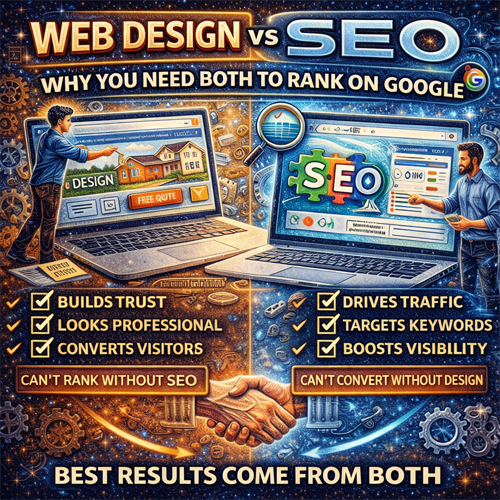
In simple terms, web design helps people trust and use your site. SEO helps people find it in the first place. That is why one without the other often limits results.
A Great Design Without SEO Can Struggle
Some businesses invest heavily in design and branding, expecting the website to naturally bring in business once it launches. But websites do not rank well just because they look polished. If the site is missing proper optimization, Google may not understand what the pages are about, which searches they should rank for, or how the structure of the site supports relevance.
This often leads to frustration. The website may look modern and professional, yet receive very little organic traffic. The business then has to rely more heavily on paid ads, referrals, or social media just to bring in visitors.
A visually impressive site is valuable, but it becomes much more valuable when search engines can actually discover and interpret it correctly.
SEO Without Good Design Can Also Fail
On the other side, some websites focus so much on SEO that they forget the human experience. They may target keywords, add service pages, and create search-friendly content, but if the site feels cluttered, confusing, slow, or outdated, visitors may leave quickly.
Ranking is only part of the goal. Once people arrive, they need to trust the business and know what to do next. Poor design can hurt that. If the site is hard to navigate, difficult to read on mobile, or visually weak, it may fail to turn search traffic into leads or customers.
This is why traffic alone is not enough. A website needs both visibility and usability if it is going to produce real business results.
Google Rewards Strong User Experience
Google wants to rank websites that help users. That means the search engine pays attention to more than keywords alone. Page speed, mobile friendliness, readability, structure, and ease of navigation all play a role in how a website performs.
These factors sit at the intersection of web design and SEO. For example:
- A fast-loading site supports both rankings and user satisfaction
- A mobile-friendly layout helps both usability and search visibility
- Clear page hierarchy improves both readability and crawlability
- Logical navigation helps both visitors and search engines understand the site
This overlap is exactly why design and SEO should be planned together rather than treated like separate projects.
Site Structure Depends on Both Design and SEO
A strong website structure is part design decision and part SEO strategy. Menus, categories, service pages, internal links, and page hierarchy all affect how users move through the site and how search engines interpret it.
When design and SEO work together, the result is a site structure that feels natural to visitors while also giving Google clear signals about the purpose of each page. Important pages become easier to find, supporting pages become easier to crawl, and the overall website becomes more organized.
When these disciplines are disconnected, the site may end up with confusing navigation, weak internal linking, or pages that do not clearly support one another.
Content Layout Affects Rankings and Conversions
Even content presentation is influenced by both web design and SEO. Search engines need content to be structured clearly, with strong headings, readable paragraphs, logical sections, and relevance to user intent. Visitors need that same content to feel useful, easy to scan, and visually inviting.
A page can have valuable content but still underperform if it feels overwhelming or poorly organized. Likewise, a page can look attractive but fail if it does not include enough useful information or clear relevance.
The best-performing pages usually combine:
- Clear headline structure
- Useful and relevant content
- Strong visual organization
- Simple calls to action
- Mobile-friendly readability
That combination supports both rankings and conversions.
Local Businesses Especially Need Both
For local businesses, the relationship between design and SEO is even more important. A local website needs to communicate trust quickly while also supporting location-based search visibility. That means the site should look professional, clearly explain services, and be structured to support local intent.
Examples include:
- Location-specific service pages
- Clear name, address, and phone information
- Local trust signals such as reviews and testimonials
- Fast mobile performance for users on the go
- Clear calls to action for calls, quotes, or appointments
A local business site that ranks but looks weak may lose trust. A site that looks strong but is not optimized locally may never get seen. That is why both matter.
Why the Best Websites Are Built With Both From the Start
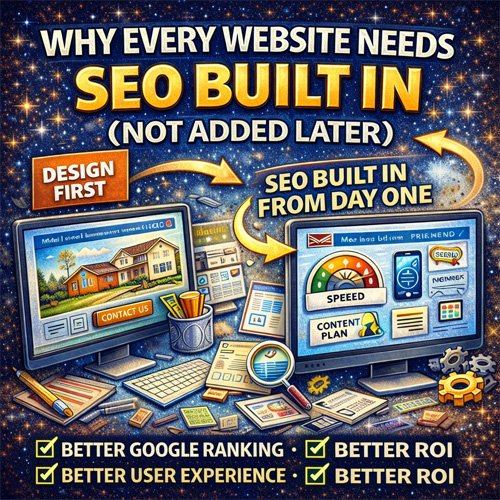
When design and SEO are planned together from day one, the website usually performs better across the board. Pages can be structured around search intent, built with mobile usability in mind, written with strong headings and metadata, and designed so the user journey feels clear.
This saves time and often reduces the need for expensive revisions later. Instead of redesigning pages to fix SEO issues or restructuring content to improve usability, the site starts with a stronger foundation.
That foundation can support better rankings, better user engagement, and better conversion performance over time.
What a Balanced Website Usually Includes
A website that blends design and SEO effectively often includes:
- Clean, modern design that builds trust quickly
- Fast load speed for better experience and visibility
- Mobile-responsive layout for today’s users
- Clear navigation and site structure
- Pages built around search intent
- Optimized title tags and headings
- Strong internal linking
- Calls to action that guide visitors toward contact or conversion
None of these elements should exist in isolation. They become more powerful when they support one another.
Final Thoughts
Asking whether web design or SEO matters more misses the real point. If you want to rank on Google and turn that visibility into real business growth, you need both. Design helps people trust, engage, and convert. SEO helps people find your site in the first place. One drives experience. The other drives discovery.
At WebDesignerProSEOExpert.com, the most effective websites are not built around design alone or optimization alone. They are built where both meet. That is where stronger rankings, stronger user experience, and stronger business results begin.